
Loan waivers will never be enough. Reforming the agricultural marketing system is essential to addressing the concerns of farmers in a sustainable manner, says Nitin Desai.
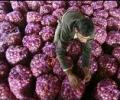
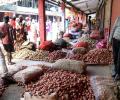
Onion prices crashed to Rs 5-20 a kg in wholesale markets of the national capital on Tuesday on the back of improved supply, but retail prices of the vegetable remain high at Rs 40 per kg.

The government has identified nine key focus areas in the AI national programme, including agriculture, education, Indian languages, smart cities, cybersecurity, transportation, and finance.

'The policy is to consolidate farming into the hands of a few and to take away the food security of the country.' 'Once food is in the hands of 15 chosen corporate houses, you will get food, but at a price that they determine.'
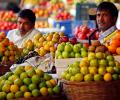
Nearly a third of an average Indian citizen's consumption budget is spent on food.

In a breakthrough that could end the political uncertainty in Pakistan, the Pakistan Muslim League-Nawaz and the Pakistan Peoples Party have agreed on a power-sharing deal to form a new coalition government after intense negotiations following a fractured poll verdict.

The economy may grow by around 7 per cent this financial year as estimated by the Monetary Policy Committee (MPC) of the Reserve Bank of India (RBI), say economists with various organisations. The first advance estimates for 2023-24 will be released on Friday by the National Statistical Organisation (NSO), an exercise done for calculating ratios such as the fiscal deficit. The interim Budget will be presented on February 1.
Kiran Vissa, co-convenor of National Alliance for Sustainable Agriculture, said that amendments to the EC Act have nothing to do with farmers' welfare but instead meant to please big players and agriculture companies. This is because small and marginal farmers don't have the storage capacity to attract provisions of the EC Act.
'To bring about a paradigm shift in farmers's income, we need to change our approach to agriculture, and transit from the narrow prism of cultivation to a full-fledged enterprise, by building all associated supply chain linkages.' 'This alone will make the farmer an entrepreneur in his own right.'
The government was going in the "wrong direction" and it was "highly condemnable" that it did not discuss the proposed changes with trade unions and other stakeholders, says BMS, trade union arm of the RSS.

The Left leader said the NCERT, which was set up on the basis of the 2005 National Curriculum Framework, has been demolishing the very goals of the NCF through the removal of such passages from textbooks.

Thousands of farmers, mainly from Punjab and Haryana, are protesting at various borders of the national capital for more than a month against the laws and are demanding that these be repealed.

A large car caravan of protesters from various parts of California blocked the traffic on the Bay Bridge on Saturday as they moved towards the Indian Consulate in San Francisco, while several hundreds gathered in downtown Indianapolis.

The minister said this underlying resentment and pain of those countries regarding the global economy was building up for the last 15-20 years and the COVID-19 pandemic and the Ukraine conflict resulted in prices of energy and food items going up.

National Agricultural Cooperative Marketing Federation, the central government's procurement agency for non-cereal crops, is in talks with leading retail companies to serve as a back-end supply chain in agri-commodities.
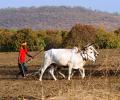
'We will be hoisting the tiranga, but this kind of celebration is uncalled for when the farmers in this country are dying by suicides, their families are ravaged by poverty and farmers are not enjoying any freedom.'

Releasing the manifesto titled 'Badlav Ka Sankalp' (commitment to change) in the presence of All India Congress Committee (AICC) general secretary Randeep Singh Surjewala and other Mahagathbandhan leaders, Tejashwi Yadav said their government, if elected, would first approve the process for appointments on about 10 lakh jobs in the government.

"On space, we will be able to announce that India is signing the Artemis Accords, which advance a common vision for space exploration for the benefit of all humankind," a senior administration official said hours before the meeting between Prime Minister Narendra Modi and President Joe Biden in the Oval Office.
Critics argue that much more could have been done and that the government was slow to react to many events.

Concerned over skyrocketing prices of onion due to supply scare in the market, government on Monday decided to import onions from China and Pakistan to tide over the crisis.

As per the NCERT, the decision has been taken to reduce the content load on students in view of the COVID-19 pandemic.
People in the know said plans were afoot to begin the sale of all food grains through online, with a major quantity through auctions that would be later extended to other commodities.


Shaktikanta Das said in Washington, DC, that there was nothing sacrosanct about the 25 bps rate cut and that monetary policy could be well served by calibrating the size of the policy rate to the dynamics of the situation, and the size of the change itself could convey the stance of policy.
The National Agricultural Cooperative Marketing Federation of India Ltd has decided to actively trade in imported edible oils after failing to procure sufficient quantity of mustard seeds from the domestic market due to high price.

The Nafed has outstanding dues of Rs 224.26 crore (Rs 2.24 billion) as of February 15.

In terms of value, this translates into more than Rs 300 crore (Rs 3 billion) of delivered quantity.

India has agreed to allow import of pork and pork products from the US as a part of a bilateral trade deal which will facilitate export of Indian mangoes and pomegranate to the US. The development comes months after the two governments renewed the India US Trade Policy Forum (TPF), after which both nations agreed to iron out thorny issues that included market access issues pertaining to the agriculture sector.

5G ambulances will not just allow remote consultation, but would also be able to transit data and video to hospitals in real time, saving precious time for critical patients. 5G technology would also support the development of new educational applications, improve agriculture productivity, and aid search and rescue missions with high resolution cameras in disaster recovery zones.

Data shows that the current system of decentralised marketing and centralised procurement helps Punjab and Haryana farmers the most, while its efficacy in other states has been poor. Experts and farm leaders say success of the laws rests heavily on implementation.

In 2018, Mr Chouhan became chief minister for the fourth time with some support from Mr Scindia. This time, nothing can be said with any certainty.
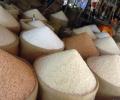
India believes rich nations should be away from farm subsidies.

The most immediate challenge for growth is the disruption of the global economy brought about by the Ukraine war and related sanctions, the Covid shutdowns in China and the rising tide of inflation, points out Nitin Desai.
A report by international agency Oxfam on Monday flayed rich countries for using World Trade Organisation
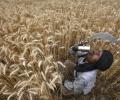
But the measures, particularly in agriculture, may not be enough to revive the sector and double the farm income, says S Mahendra Dev.
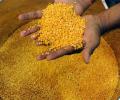
At an average national price of Rs 90 a kg in the retail market, it shows a jump by 20% in the last two months.
The MEP has been raised from $225 a tonne in May to $495 a tonne in October. Despite this, domestic onion prices have risen sharply. They are currently available at Rs 24 -28 per kg at the retail level, compared with Rs 8-10 a kg in May.

Prime Minister Narendra Modi on Tuesday launched 35 crop varieties with special traits -- developed by the Indian Council of Agricultural Research (ICAR) -- to address the twin challenges of climate change and malnutrition. The new crop varieties were dedicated to the nation through a video conference organised at all ICAR institutes, state and central agricultural universities and Krishi Vighyan Kendra. According to the PMO, 35 crop varieties with special traits like climate resilience and higher nutrient-content have been developed in 2021.
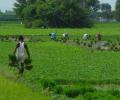
President Ram Nath Kovind on Monday said the country's farm production and procurement increased during 2020-21 crop year despite the pandemic and agricultural exports reached a record level of Rs 3 lakh crore during the same period. In his address to the joint sitting of both Houses of Parliament at the start of the Budget session, Kovind said the government is focusing on making the country self-sufficient in edible oils besides making special efforts to promote organic farming, natural farming and crop diversification. "My government is working continuously to empower the farmers and the rural economy of the country... I would like to give maximum credit to the small farmers of the country for this consistent success and strengthening of the agriculture sector," he said.

If India wants to become a globally competitive manufacturing hub, it will have to rethink the notion that the traditional SMEs will form the manufacturing backbone, argues Prosenjit Datta.
